


When you think of fish, you probably imagine creatures with jaws, fins, and scales. But long before modern fish evolved, there existed a much simpler—and fascinating—group known as jawless fish. Scientifically called Agnatha, these ancient vertebrates represent the earliest stage of fish evolution. Jawless fish have survived for over 500 million years, making them one of the oldest living groups of vertebrates on Earth. Their simple body structure, lack of jaws, and unusual feeding habits make them both unique and scientifically important. In this complete guide, you’ll explore everything about jawless fish—from their characteristics and types to their habitat, ecological role, and importance in modern science.
Jawless fish are primitive vertebrates that lack jaws and paired fins. Instead of jaws, they have a circular, sucker-like mouth, which they use to feed in very different ways compared to other fish. Unlike bony fish and cartilaginous fish, jawless fish have a simple cartilaginous skeleton and smooth, scaleless skin. Their body structure may seem basic, but it has allowed them to survive major changes in Earth’s environment over millions of years. These fish are often referred to as “living fossils” because they closely resemble some of the earliest vertebrates found in the fossil record.
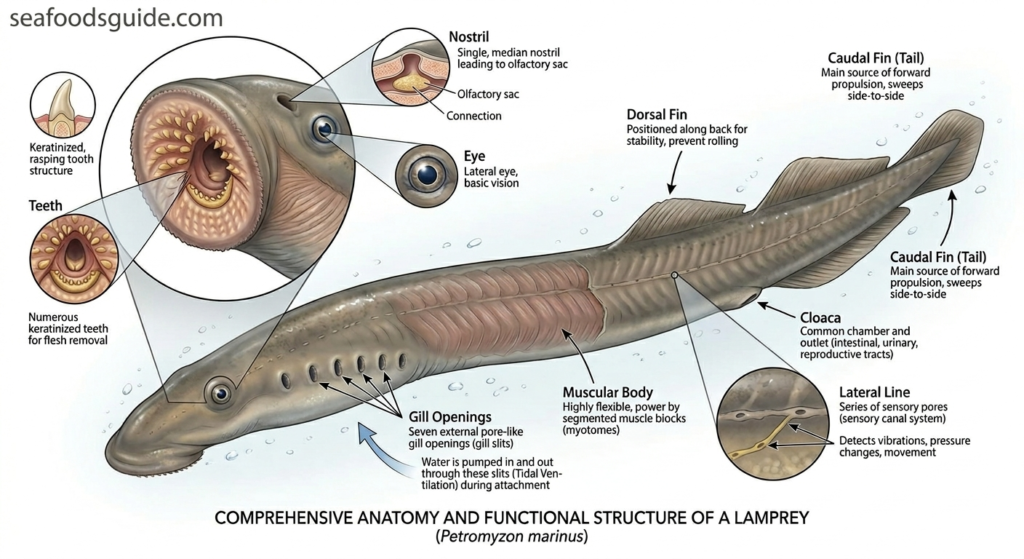
Jawless fish belong to the group Agnatha, which includes animals like lamprey and hagfish. They are considered the most primitive (early-evolved) vertebrates. Here are their key characteristics:
As the name suggests, they lack true jaws.
Instead, they have a circular, sucking mouth with tooth-like structures.
Their skeleton is made of cartilage, not bone.
This makes their body softer and more flexible.
They do not have paired fins (like pectoral or pelvic fins).
Movement is achieved through body undulations.
Long, slender, and eel-like body.
Smooth skin without scales.
They have several gill pores instead of a single gill cover.
Used for breathing in water.
They retain a notochord throughout life.
Acts as the main supporting structure.
The heart has two chambers (one atrium and one ventricle).
Blood circulation is relatively simple.
Many are parasitic (like lampreys, which attach to other fish).
Hagfish are mostly scavengers, feeding on dead animals.
Hagfish produce large amounts of slime as a defense mechanism.
This helps them escape predators.
Body temperature depends on the surrounding environment.
Jawless fish are found in a variety of aquatic habitats, depending on the species.
Most hagfish live in deep oceans
Some lampreys spend part of their life in the sea
Rivers and lakes are common habitats for lampreys
Many species spawn in freshwater
Hagfish thrive in dark, cold ocean depths
They play an important role in recycling nutrients
Their adaptability to different environments has helped them survive for millions of years.
Jawless fish have developed unique feeding strategies:
Attach to the host fish
Use teeth to scrape flesh
Feed on blood and body fluids
Feed on dead animals (scavenging)
Use knotting behavior to tear flesh
Play a key role in cleaning the ocean floor
These feeding methods may seem unusual, but they are essential for maintaining ecological balance.
Jawless fish play several important roles in aquatic ecosystems:
Parasitic lampreys help regulate fish populations, preventing overpopulation in certain environments.
Hagfish act as natural recyclers, breaking down dead organisms and returning nutrients to the ecosystem.
They serve as food for larger predators, contributing to the aquatic food web.
Jawless fish are extremely valuable in biological research. Scientists study them to understand:
Early vertebrate evolution
Development of the nervous system
Immune system functions
While jawless fish are not as commercially important as other fish:
Lampreys are consumed as food in some cultures
Hagfish skin is used to produce a material known as “eel leather”
Provide insight into early evolution
Help maintain ecological balance
Unique biological features useful for research
Important in nutrient cycling
Parasitic lampreys can harm fish populations
Limited commercial value
Often considered unattractive or harmful
Some species can become invasive
Feature | Jawless Fish | Bony Fish | Cartilaginous Fish |
Jaws | Absent | Present | Present |
Skeleton | Cartilage | Bone | Cartilage |
Fins | No paired fins | Paired fins | Paired fins |
Mouth | Sucker-like | Standard jaws | Standard jaws |
Examples | Lamprey, Hagfish | Salmon, Tuna | Sharks, Rays |
Although jawless fish have survived for millions of years, some species now face threats due to:
Water pollution
Habitat destruction
Climate change
Interestingly, in some regions (like the Great Lakes), invasive lamprey species are actively controlled to protect native fish populations.
Conservation efforts focus on:
Protecting freshwater habitats
Monitoring populations
Controlling invasive species

Seafood Restaurants Amsterdam Ultimate Seafood Guide 2026: Best Restaurants,...

+923288172216
seafoodsguide@gmail.com

We share helpful and educational content about seafood, covering various types of fish and shellfish, their benefits, and their role in global cuisine and nutrition. Our content is designed to be easy to understand and useful for anyone interested in seafood.
Subscribe to our newsletter to receive the latest informational content about seafood, including different types of fish and shellfish, their benefits, and useful guides. Enter your email to stay updated with our newest seafood articles.