

Have you ever stood at a seafood counter wondering why shrimp, crabs, and lobsters look so similar yet taste so different? This guide quickly clears up the matter.
Crustaceans are aquatic animals with hard exoskeletons, jointed limbs, and two pairs of antennae. They belong to the arthropod group, which also includes insects and spiders. Crustaceans include shrimp, crabs, lobsters, crayfish, krill, and barnacles, among others. Most inhabit the oceans, though many species thrive in fresh water, and a few even live on land. Here is what you will learn: we will cover the main types of crustaceans, their anatomy, the molting process, their habitats, diets, and life cycles. We will also look at the journey these animals take to reach American dinner tables and the reasons why shrimp dominate seafood consumption in the USA. The facts presented here are based on marine biology sources and data from NOAA Fisheries and the National Fisheries Institute, so you can be confident in their reliability.
Crustaceans are invertebrates belonging to the subphylum *Crustacea* within the phylum *Arthropoda* (arthropods). They are characterized by a segmented body, a hard exoskeleton, jointed limbs, and two pairs of antennae. Most of them live in water; scientists have described tens of thousands of species.
The name derives from the Latin word *crusta*, meaning shell or armor. This is an apt description, as the external shell is the first feature most people notice. These animals vary greatly in size: from tiny copepods—smaller than a grain of rice—to the Japanese spider crab, which can have a leg span exceeding 3.6 meters (12 feet).
Key information:
Classification: Kingdom *Animalia* (animals), phylum *Arthropoda* (arthropods), subphylum *Crustacea* (crustaceans)
Backbone: None (they are invertebrates)
Examples: Shrimp, crabs, lobsters, crayfish, krill, and barnacles
Habitat: Oceans, rivers, lakes, and even some terrestrial environments
Crustaceans vs. shellfish: The term “shellfish” refers to a culinary category rather than a scientific taxonomic group. It encompasses both crustaceans and mollusks, such as oysters, clams, and mussels. So, a shrimp is a seafood, but an oyster is not a crustacean. Being aware of this distinction makes it easier to read product labels and restaurant menus.
Crustaceans are distinguished by five main features: a hard outer shell (exoskeleton), jointed limbs, two pairs of antennae, a segmented body, and gills for respiration. These traits set them apart from other arthropods, such as insects and spiders.
Here are the five characteristic features:
Exoskeleton: A tough outer shell, composed primarily of chitin, protects the body from predators and water loss. Since this shell does not stretch, crustaceans must molt in order to grow.
Jointed limbs: The term “arthropod” literally means “jointed-foot” animal. Crustacean limbs are adapted for various functions: walking, swimming, grasping food, or carrying eggs.
Two pairs of antennae: These serve to detect food, water movement, and threats. Insects have only one pair of antennae, making it easy to distinguish them from crustaceans.
Segmented body: In most species, the head and thorax are fused into a cephalothorax, while the abdomen forms a separate body section.
Gills: Almost all crustaceans breathe using gills—this applies even to terrestrial species, which require a moist environment to survive.
It is also worth mentioning their mouthparts. Mandibles function as jaws for biting and tearing food, while the maxillae (true jaws) assist in holding and manipulating it.
Expert tip: Not sure if the small creature you’ve found is a crustacean? Count its antennae and look for gills or a hard, segmented shell. The common garden woodlouse (or pillbug) passes this test—a fact that often surprises people.
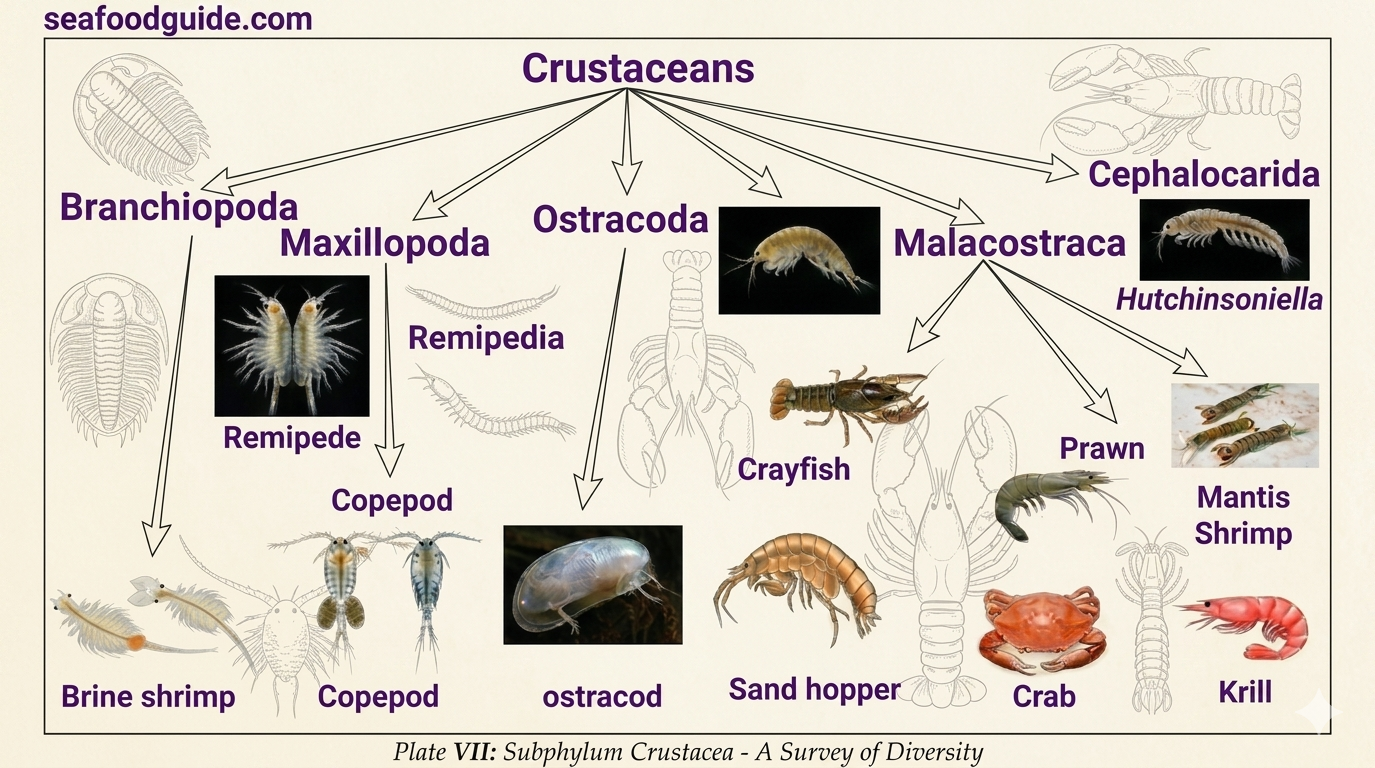
Major groups of crustaceans include shrimp, crabs, lobsters, crayfish, krill, and barnacles, as well as a vast array of tiny species such as copepods. Most belong to the order Decapoda, though the group also encompasses animals that bear no resemblance to the typical seafood served on a plate.
These streamlined, swimming creatures inhabit oceans, estuaries, and some freshwater environments. Scientists distinguish between specific types of shrimp based on gill structure and body shape, though these names are often used interchangeably on American menus.
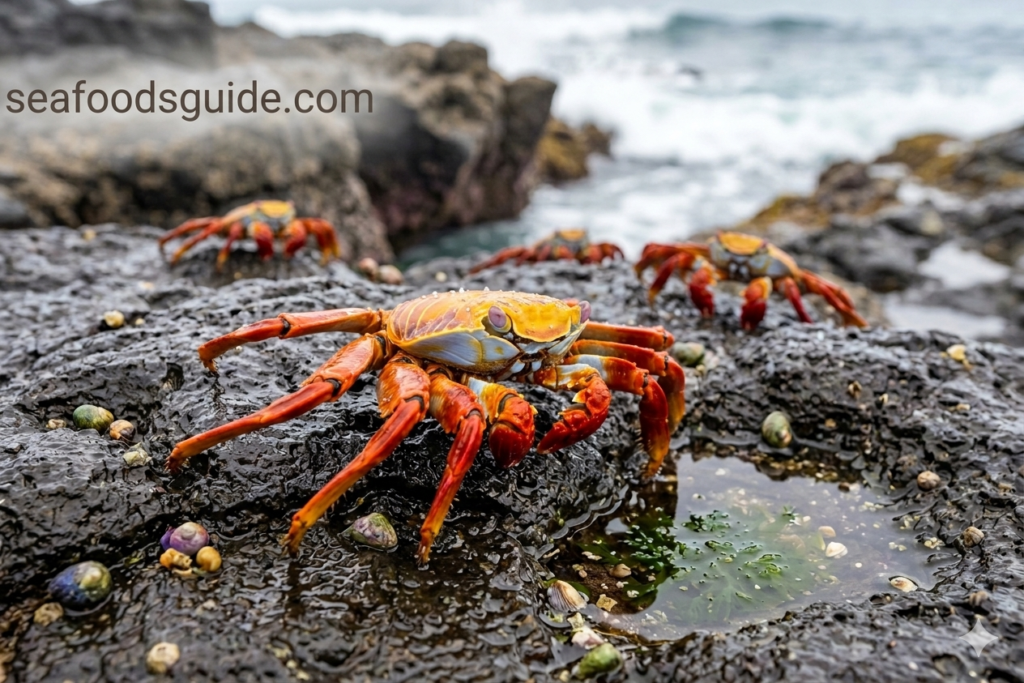
Crabs are characterized by a broad, flat body, a short abdomen tucked underneath, and powerful claws. Popular species include the blue crab, Dungeness crab, and king crab.
American lobsters possess two large pairs of claws and live on the seabed in the cold waters off the coast of New England. Spiny lobsters lack such impressive claws. Crayfish are their freshwater cousins; in Louisiana, they are known as *crawfish*.
Krill are tiny, shrimp-like animals that move in massive swarms. Antarctic krill serve as food for whales, seals, and penguins, thereby forming the foundation of entire food webs.
Barnacles come as a surprise to many people. Their larvae swim freely, but the adults attach themselves head-first to rocks, pier pilings, or ship hulls, subsequently filtering food using feathery appendages.
Copepods, amphipods, brine shrimp, and water fleas are barely visible to the naked eye, yet they serve as food for countless fish. Even the common woodlouse found in a backyard garden is actually a terrestrial crustacean.
A crustacean’s body consists of three main parts: the head, the thorax, and the abdomen. In crabs, lobsters, and shrimp, the head and thorax fuse into a single unit called the cephalothorax, which is covered by a shell (carapace). Behind this lies the abdomen, which in many species terminates in a fan-like structure known as the telson.
Key external body parts:
Antennae: Detect chemical substances, tactile stimuli, and water movement.
Compound eyes: Often mounted on movable stalks, providing a wide field of view.
Mandibles and maxillae: Used for grasping, biting, and crushing food.
Chelipeds: Claws found on crabs, lobsters, and crayfish.
Pereiopods: Walking legs. Decapods have five pairs of these (the name literally means “ten legs”).
Pleopods: Swimming legs located beneath the abdomen; they assist in swimming and carrying eggs.
Internally, crustaceans possess an open circulatory system. A heart located in the rear of the body pumps blood (known as hemolymph) so that it flows directly over the internal organs. Their digestive tract is a simple canal equipped with a “gastric mill”—a set of grinding plates within the stomach that break down food. Subsequently, digestive glands absorb nutrients.
Practical tip: When opening a lobster, you may notice a greenish substance inside—this is the digestive gland, often called *tomalley*. Some health authorities advise caution regarding its consumption, so it is worth checking current recommendations before eating it.
Crustaceans belong to the phylum Arthropoda and the subphylum Crustacea. Biologists traditionally divide them into six classes, with one of them—Malacostraca—encompassing almost all the species found on dinner plates.
Here are the six classes:
Malacostraca: The largest class. It includes crabs, lobsters, shrimp, crayfish, krill, and woodlice (pill bugs).
Branchiopoda: Mostly small freshwater animals, such as brine shrimp (*Artemia*) and water fleas (*Daphnia*).
Maxillopoda: Traditionally includes barnacles and copepods.
Ostracoda: Tiny animals enclosed in a bivalved shell.
Remipedia: Rare, blind crustaceans inhabiting deep marine caves.
Cephalocarida: Small bottom-dwelling animals with a horseshoe-shaped head shield.
Within the class Malacostraca, the order most important to seafood lovers is Decapoda (decapods). These animals possess ten walking legs; the group includes shrimp, crabs, lobsters, and crayfish. Krill, however, belong to a separate order called Euphausiacea.
Modern science, however, is changing this classification. Genetic studies indicate that insects evolved from the crustacean lineage. Many researchers now use the term Pancrustacea to refer to the group comprising both crustaceans and insects. Older textbooks still treat crustaceans as a distinct group, so both classification approaches may be encountered.
Most crustaceans live in the oceans, but they also thrive in fresh water and, in some cases, on land. Marine crustaceans make up the vast majority of species. They are found everywhere: from sunlit tide pools to the deepest ocean trenches.
Where crustaceans live:
Oceans and the seabed: Lobsters, crabs, and shrimp move (walk or swim) along the bottom, ranging from shallow coastal waters to the deep sea.
Estuaries and bays: Blue crabs and many shrimp species use these brackish waters as nursery grounds for their young; examples include Chesapeake Bay and the Gulf of Mexico coast.
Open waters and polar seas: Krill and copepods drift as plankton, with Antarctic krill forming massive swarms.
Rocky shores: Barnacles attach themselves to rocks, pier pilings, and boat hulls, exposed to the action of waves and tides.
Fresh water: Crayfish, freshwater shrimp, and water fleas (Daphnia) inhabit rivers, lakes, ponds, and swamps.
Land: Land-dwelling species include woodlice (pill bugs) and terrestrial hermit crabs. The palm crab (also known as the coconut crab) is the largest land-dwelling arthropod. Terrestrial crustaceans still breathe using gills or gill-like organs, which is why they inhabit moist environments to keep these structures in proper condition.
Expert tip: The habitat influences the taste and quality of the meat. Lobsters from the cold waters off the coasts of Maine and Atlantic Canada grow slowly and are prized for their firm, sweet meat, whereas shrimp from the warm waters of the Gulf of Mexico grow rapidly and often have a milder flavor.
Crustaceans feed on a wide range of items—from microscopic plankton to dead fish. Most are omnivores, scavengers, or filter feeders, while a smaller group consists of active predators. What a specific species eats depends on its size, habitat, and mouthpart structure.
Main feeding strategies:
Filter feeders: Krill, barnacles, and many copepods strain plankton, algae, and bacteria from the water. Barnacles capture food by sweeping the water with their feathery appendages.
Predators: Lobsters and many crab species hunt clams, snails, worms, and small fish. Their claws crush shells or tear prey apart.
Scavengers: Crabs, shrimp, and crayfish feed on dead animals and plant debris on the seabed, helping to keep the water clean.
Detritivores: Amphipods and isopods feed on decaying leaves and other organic matter.
Omnivores: Crayfish eat plants, insects, snails, and small fish—depending on what they can find.
Food processing begins with the mandibles and maxillae, which grasp and break down the food. Inside the stomach, a structure known as the gastric mill grinds the food into fine particles before digestive glands absorb the nutrients. The diet of crustaceans also explains why they play such a vital role in the ocean ecosystem. Krill convert tiny plankton into food for whales, penguins, and fish, thereby linking the smallest organisms with the largest.
Practical tip: If you keep crayfish or freshwater shrimp in an aquarium, provide them with a varied diet that includes sinking pellets, algae, and briefly boiled (blanched) vegetables.
Crustaceans grow through molting—the process of shedding their old outer shell (exoskeleton) and producing a new, larger one. Scientists call this process *ecdysis*. Since the shell cannot stretch, the crustacean must escape it as soon as it becomes too tight.
The molting process:
Pre-molt phase: A new, soft shell forms beneath the old one. The animal often stops feeding and stores up energy.
Ecdysis (actual molting): The old shell splits open, and the crustacean emerges—sometimes in just a few minutes.
Post-molt phase: The body expands by absorbing water, stretching the new shell; then, over the course of hours or days, minerals cause the shell to harden.
Hormones determine the timing of molting; young crustaceans molt frequently because they grow rapidly. Adults molt less often, and for some, the process slows significantly with age.
The soft-shell period is the most dangerous time. Deprived of protection, the crustacean becomes easy prey, so most hide in burrows, rock crevices, or seagrass beds until the new shell hardens. Molting also allows for the regeneration of lost limbs. A crab that has lost a claw can regrow it over one or more molting cycles.
Why does this matter to Americans? Soft-shell crab is a seasonal delicacy, particularly popular in the Chesapeake Bay region. Fishermen harvest blue crabs just after they molt—before their shells harden—making the entire animal suitable for cooking and eating.
Most crustaceans reproduce sexually and are dioecious (having separate sexes). After mating, larvae hatch from the eggs; they bear no resemblance to the adults and grow by passing through successive molting stages until they reach their adult form.
Typical crab life cycle:
Mating and eggs: The female stores sperm and carries fertilized eggs beneath her abdomen. A single crab can carry anywhere from thousands to millions of eggs.
Nauplius or zoea larva: Tiny larvae hatch from the eggs and drift with the plankton, molting as they grow.
Megalopa: This transitional stage resembles a crab with a tail; the animal is capable of both swimming and crawling.
Juvenile crab: The megalopa settles on the seabed and molts, transforming into a juvenile crab.
Adult: The crab continues to molt—though less frequently with age—until it reaches maturity.
Not every species follows this pattern. Lobsters carry their eggs on their abdominal appendages (swimmerets), whereas many commercially fished shrimp species release their eggs directly into the water. Barnacles are hermaphrodites—meaning each individual possesses organs of both sexes—and their larvae settle on hard substrates, remaining there for the rest of their lives. Some water fleas and brine shrimp can even reproduce without a mate, through a process known as parthenogenesis.
Expert tip: If you see the term “berried” or “in berry” on a lobster label, it means the female is carrying eggs. Many American fisheries require that egg-bearing females be released back into the water to protect future catches.
Shrimp is the most popular seafood in the United States, and crustaceans as a group dominate the market. According to data from the National Fisheries Institute, the average American consumed approximately 5.5 pounds (approx. 2.5 kg) of shrimp in 2022, part of a total seafood consumption of 19.7 pounds (approx. 8.9 kg) per capita. Crabs also made the list of the ten most popular species.
The “Big Four” on American plates:
Shrimp: Sold peeled, deveined, breaded, or in the shell. Most are imported; about 80% of imported shrimp are farmed products, primarily from Asia, Ecuador, and India.
Crabs: Blue crab, Dungeness crab, snow crab, and king crab—each is a key part of local culinary traditions.
Lobsters: In 2018, US lobster landings reached a record market value of approximately $684 million. Supply levels fluctuate; in 2025, the lobster catch in Maine dropped by about 8 million pounds.
Crayfish: A delicacy popular in Louisiana and the Gulf of Mexico region; they are boiled by the sackful every spring.
Imports play a crucial role in the category as a whole. Over 90% of the seafood consumed in the USA is imported. That is why it pays to read the labels.
Shopping tip: Check the country of origin and the packaging to see whether the product is farmed or wild-caught. If you care about sustainable fishing, look for MSC or ASC certifications or Seafood Watch ratings.
Beyond their role in our diet, crustaceans play a crucial role in marine food webs, provide raw materials for industry, and help scientists monitor water quality. Few animal groups perform such vital work while remaining largely out of the spotlight.
Key functions and uses:
Food web foundation: Krill and copepods convert plankton into food for fish, seabirds, seals, and whales. Copepods are among the most abundant animals on Earth.
Chitin and chitosan: Shrimp and crab shells contain chitin, which is processed into chitosan. It is used in wound dressings, water filtration systems, and agricultural products.
Supplements: Krill oil is sold as an omega-3 supplement, though it is advisable to consult a doctor before use.
Aquaculture feed: Brine shrimp (*Artemia*) serve as a standard initial food source for fish fry and juvenile shrimp in hatcheries.
Bait and fisheries: Crabs, shrimp, and crayfish are used as bait in both recreational and commercial fishing.
Science and monitoring: Water fleas (*Daphnia*) are widely used in toxicity tests because they react quickly to the presence of pollutants.
Some crustaceans can also be a nuisance. Barnacles attach themselves to ship hulls and port structures (a phenomenon known as biofouling), leading to increased fuel consumption and maintenance costs.
Expert tip: Shells don’t have to go to waste. By simmering them with vegetables, you can make a delicious homemade seafood stock.
Shellfish allergy is one of the most common food allergies in the United States and is distinct from fish allergy. The U.S. Food and Drug Administration (FDA) classifies shellfish as one of the nine major food allergens. The primary trigger for a reaction is a muscle protein called tropomyosin, found in shrimp, crabs, lobsters, and crayfish. If you suspect an allergy, consult an allergist; do not attempt to perform tests yourself at home.
Basic safety guidelines:
Keep it cold: Store raw shellfish at 4°C (40°F) or lower and use them promptly.
Cook thoroughly: The FDA recommends reaching an internal product temperature of 63°C (145°F). Once cooked, shrimp and lobster meat becomes opaque and takes on a pearly hue.
Handle live animals with care: Cook live crabs and lobsters shortly after purchase; discard any that have died before cooking.
Avoid cross-contamination: If someone at the table has an allergy, use separate cutting boards and kitchen utensils.
Responsible shopping requires only a quick check of a few details. Look for the Marine Stewardship Council (MSC) label on wild-caught products and the Aquaculture Stewardship Council (ASC) certification on farmed products. The “Seafood Watch” guide, developed by the Monterey Bay Aquarium, evaluates species based on region and fishing method.
Expert tip: Ask the fishmonger where the shrimp come from and how they were farmed. A good fishmonger will know the answer, and the information you receive will tell you a lot about the product’s quality.
Crustaceans are far more than seafood. They are armored, jointed legged arthropods that shape ocean food webs, from tiny copepods to giant crabs. You now know how to spot their key traits, tell shrimp from prawns, and understand molting, habitats, diet, and life cycles. You also know why shrimp leads American seafood and how to buy crustaceans safely and sustainably.
Your next step is simple. Next time you shop, check the label for origin, farmed or wild status, and MSC or ASC certification. If you cook shellfish at home, follow safe handling rules and keep allergies in mind.
Looking ahead, search in 2026 rewards clear, well sourced answers that people and AI assistants can trust. Bookmark this guide and share it with anyone curious about the animals behind the menu.
Seafood Restaurants Amsterdam Ultimate Seafood Guide 2026: Best Restaurants,...
+923288172216
seafoodsguide@gmail.com

We share helpful and educational content about seafood, covering various types of fish and shellfish, their benefits, and their role in global cuisine and nutrition. Our content is designed to be easy to understand and useful for anyone interested in seafood.
Subscribe to our newsletter to receive the latest informational content about seafood, including different types of fish and shellfish, their benefits, and useful guides. Enter your email to stay updated with our newest seafood articles.