

Most people can’t tell you what actually separates a goldfish from a shark, and that gap in understanding makes fish biology feel more confusing than it needs to be. Here’s the good news: once you understand one core distinction, everything else clicks into place. A bony fish is any fish with a skeleton made of true, hardened bone rather than cartilage, placing it in the scientific group Osteichthyes. This single group includes more than 28,000 species and makes up over 95% of all fish on Earth, from tiny goldfish to massive tuna.
In this guide, you’ll learn exactly what defines a bony fish, how scientists classify them, which species count as examples, and how they differ from cartilaginous fish like sharks and rays. By the end, you’ll be able to identify and explain bony fish with real confidence.
A bony fish is a vertebrate animal with a skeleton made primarily of hardened, calcified bone rather than flexible cartilage. Scientifically, bony fish belong to the superclass Osteichthyes, a Greek term meaning “bone fish.” This group represents the largest and most diverse branch of the entire fish family tree.
Osteichthyes splits into two major classes:
Before diving deeper, here’s a snapshot of the core facts about bony fish in one place, useful for quick reference or a quick answer if you’re short on time.
| Feature | Detail |
|---|---|
| Scientific name | Superclass Osteichthyes |
| Number of species | 28,000+ documented species |
| Number of families | 400+ recognized families |
| Major classes | Actinopterygii (ray finned), Sarcopterygii (lobe finned) |
| Skeleton type | Hardened, calcified bone |
| Habitat | Freshwater (about 42%) and marine (about 58%) |
| Percentage of all fish species | Over 95% |
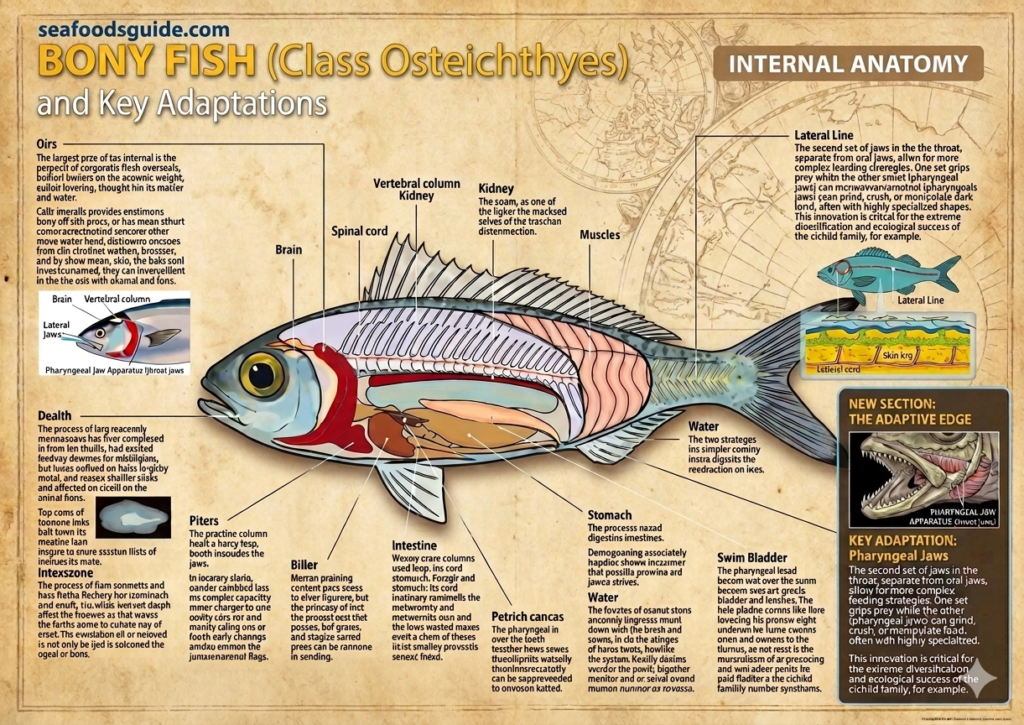
| Key organs | Swim bladder, operculum |
| Reproduction | Mostly oviparous with external fertilization |
| Notable “living fossil” | Coelacanth (Latimeria chalumnae) |

The dominant class, accounting for roughly 99% of all bony fish species. Fins are thin membranes supported by bony rays.
Major subgroups include:
A much smaller class with thick, fleshy, muscular fins containing internal bone structures.
Includes:
Bony fish share a specific set of physical traits that set them apart from every other fish group. If you remember just one thing, remember this: a true bone skeleton is the defining characteristic, and everything else builds on it.
Beyond the skeleton itself, bony fish typically display:
These traits work together as a system. A hinged jaw means little without a swim bladder to help the fish reach its prey at the right depth, and an operculum means little without gills to protect underneath it.
The swim bladder is essentially a built-in buoyancy control system. By adjusting the volume of gas inside it, a bony fish can rise, sink, or hover at a specific depth without expending extra energy swimming. This is a major evolutionary advantage over cartilaginous fish, which lack a swim bladder and must keep moving or rely on an oil filled liver to avoid sinking.
The operculum acts like a pump. It draws water in over the gills and pushes it back out, allowing continuous oxygen exchange even when the fish isn’t actively swimming. This is why a bony fish can appear almost motionless in the water while still breathing normally, something cartilaginous fish without an operculum generally cannot do as efficiently.
Bony fish scales are thin and flexible compared to the tough, tooth like placoid scales of sharks. This structure supports the vivid coloration seen in species like clownfish and mandarin fish, along with excellent color vision in most bony fish species, a trait many cartilaginous fish lack entirely.
Bony fish classification follows a clear taxonomic hierarchy, and understanding it helps explain why a goldfish and a lungfish are both “bony fish” despite looking nothing alike.
The full classification path looks like this:
This system has deep historical roots. Aristotle made some of the earliest recorded observations about fish biology, but the modern framework traces back to Peter Artedi, often called the “father of ichthyology,” whose classification methods were later adopted by Carolus Linnaeus in his landmark work, Systema Naturae. That foundation still shapes how scientists classify bony fish today.
Bony fish examples span an enormous range of sizes, shapes, and environments, which is exactly what you’d expect from a group representing over 95% of all fish species.
A quick fact worth remembering: seahorses are true bony fish, despite their unusual body shape. So are eels, despite their snake like appearance. Body shape alone is never a reliable way to identify a bony fish; skeletal structure is.
These examples matter because they demonstrate just how much variation can exist within a single, unified classification group. Few other vertebrate categories show this much diversity while still sharing one core defining trait.
The main difference between bony fish and cartilaginous fish comes down to one thing: skeletal material. Bony fish have skeletons made of hardened bone, while cartilaginous fish, such as sharks and rays, have skeletons made of flexible cartilage.
That single difference creates a cascade of other distinctions:
| Feature | Bony Fish (Osteichthyes) | Cartilaginous Fish (Chondrichthyes) |
|---|---|---|
| Skeleton | Hard, calcified bone | Flexible cartilage |
| Gill covering | Operculum | Exposed gill slits |
| Buoyancy control | Swim bladder | Oil filled liver |
| Scales | Thin cycloid or ctenoid scales | Tough placoid scales |
| Habitat | Freshwater and marine | Marine (mostly) |
| Eyelids | Absent | Present in most species |
| Reproduction | Mostly oviparous, external fertilization | Often viviparous, internal fertilization |
| Species count | 28,000+ | Around 1,200 |
Sharks and rays are not bony fish. This is one of the most common misconceptions in casual fish biology, and it trips up even experienced aquarium hobbyists. A shark’s entire skeleton, including its skull, is made of cartilage, which is lighter but less rigid than true bone.
Despite their differences, both groups share important traits. Both are vertebrates with well developed muscular systems, functioning gills for respiration, and generally streamlined bodies built for efficient movement through water. Both groups also reproduce sexually and rely on internal osmoregulation to manage salt and water balance, a critical adaptation for life in aquatic environments with varying salinity levels.
Most bony fish reproduce through external fertilization, meaning eggs and sperm meet outside the female’s body, usually in open water. This process is called oviparity, and it’s the dominant reproductive strategy across the vast majority of the 28,000+ known bony fish species.
A typical reproductive cycle looks like this:
Not every bony fish follows this pattern exactly. Seahorses are a well known exception: males carry fertilized eggs in a specialized brood pouch until they hatch, a rare example of male pregnancy in the animal kingdom. Some livebearing species, like guppies, give birth to free swimming young rather than laying eggs at all.
This contrasts clearly with cartilaginous fish, which typically rely on internal fertilization and often produce far fewer offspring per reproductive cycle but invest more biological resources in each one. Bony fish generally take the opposite strategy: produce many offspring, invest less per individual, and let natural selection determine survival.
Bony fish trace their evolutionary origins back roughly 400 million years to the Devonian period, often called the “Age of Fishes.” This era saw an explosion of vertebrate diversity in aquatic environments, setting the stage for nearly every fish species alive today.
Early Osteichthyes ancestors split into two evolutionary paths early on:
That second point carries enormous scientific weight. Sarcopterygian fish are considered the closest living relatives to the ancestors of all land vertebrates, including amphibians, reptiles, birds, and mammals. In other words, the fins on a modern lungfish share deep structural similarities with the limbs that eventually evolved into legs.
The scientific classification of bony fish has its own history worth knowing. Aristotle recorded early observations on fish biology, including noting that sea bass are hermaphroditic. Centuries later, Peter Artedi developed a systematic classification approach that Carolus Linnaeus incorporated into his foundational work, Systema Naturae, a text that still shapes taxonomic thinking today.
The rediscovery of the coelacanth in 1938 remains one of the most significant events in ichthyology, proving that entire lineages once thought extinct can persist largely unchanged for tens of millions of years.
Bony fish are essential to both aquatic ecosystems and the global economy, playing roles far beyond what most people realize. Their sheer numbers alone, over 28,000 species, make them a foundational part of nearly every freshwater and marine food web on Earth.
Ecologically, bony fish contribute in several key ways:
Economically, the impact is just as significant. Bony fish make up the overwhelming majority of global commercial and recreational fisheries. Species like tuna, cod, salmon, and mackerel support massive industries, from commercial fishing fleets to aquaculture operations that now supply a large share of the world’s seafood.
Aquaculture in particular has grown rapidly because most farmed fish species, including tilapia and catfish, are bony fish that adapt well to controlled environments. This makes bony fish not just biologically dominant, but economically indispensable to global food security.
A surprising number of widely repeated fish facts are actually wrong, and clearing these up helps build a more accurate understanding of bony fish biology.
Misconception 1: All fish are bony fish.
False. While bony fish make up over 95% of fish species, sharks, rays, and skates belong to a completely separate class, Chondrichthyes, with cartilage skeletons instead of bone.
Misconception 2: Sharks are a type of bony fish.
False. This is one of the most common mix ups in casual conversation. Sharks lack an operculum, a swim bladder, and true bone tissue, all defining traits of Osteichthyes.
Misconception 3: Bony fish have eyelids.
False, in most cases. The vast majority of bony fish species lack true eyelids and sleep with their eyes open, relying instead on reduced activity levels to rest.
Misconception 4: Body shape can tell you if a fish is bony.
False. Eels look serpentine, seahorses look nothing like typical fish, and flatfish appear almost two dimensional, yet all three are true bony fish. Skeletal composition, not appearance, is the only reliable classification factor.
Misconception 5: Bony fish can’t survive in extreme environments.
False. Bony fish thrive from high-altitude mountain streams to deep-sea trenches thousands of meters below the surface, including bioluminescent anglerfish adapted to near-total darkness.
Understanding these distinctions matters, especially since inaccurate fish facts spread quickly online and are often repeated without verification.
Bony fish represent one of the most successful and diverse groups of vertebrates on the planet, and now you understand exactly why. From their hardened bone skeletons and swim bladders to their classification into ray finned and lobe finned groups, these traits explain how a single superclass, Osteichthyes, came to include over 28,000 species across nearly every aquatic environment on Earth.
The key takeaway is simple: skeletal structure, not appearance or habitat, is what truly defines a bony fish. That’s why eels, seahorses, and tuna all belong to the same group despite looking nothing alike.
As marine biology and environmental awareness continue shaping how people search for and consume information in 2026, understanding foundational classifications like this one only becomes more valuable, both for casual curiosity and deeper scientific literacy. Next time you spot a fish, you’ll know exactly what to look for.

Seafood Restaurants Amsterdam Ultimate Seafood Guide 2026: Best Restaurants,...
+923288172216
seafoodsguide@gmail.com

We share helpful and educational content about seafood, covering various types of fish and shellfish, their benefits, and their role in global cuisine and nutrition. Our content is designed to be easy to understand and useful for anyone interested in seafood.
Subscribe to our newsletter to receive the latest informational content about seafood, including different types of fish and shellfish, their benefits, and useful guides. Enter your email to stay updated with our newest seafood articles.